Your accounting software doesn't have a cash-flow problem. It has a conversation problem.
You have already tried automating your way out of late payment. More reminders, late fees, scheduled statements. And the same customers still sit unpaid, quietly ignoring a growing stack of perfectly automated emails. Here is why, and what actually closes the gap.
The automation you have already tried
You did the sensible thing. You connected a tool to your accounting software and switched on automated reminders. Maybe late fees too, and statements that send themselves. For a week or two it felt like progress, because at last something was happening without you.
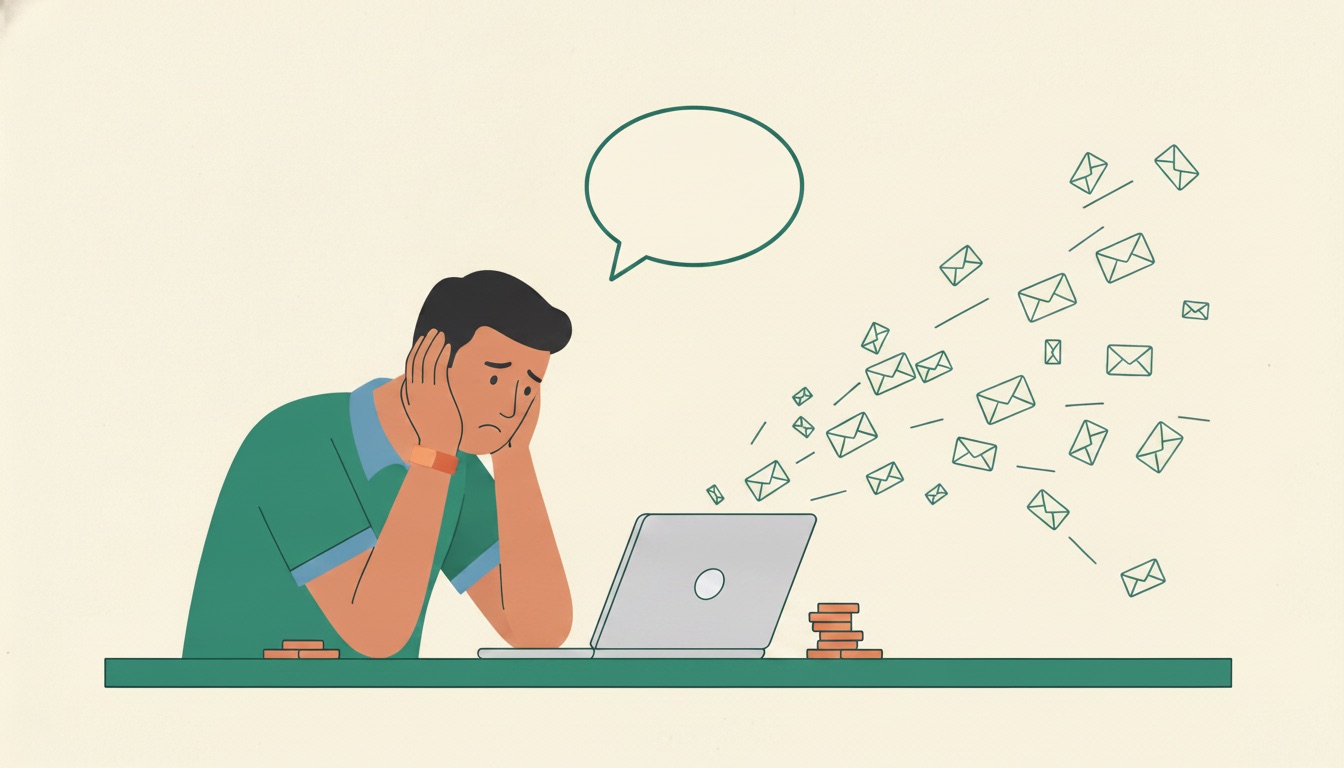
Then you looked at your overdue column and found the same names sitting in it, month after month, calmly ignoring a growing stack of beautifully formatted emails.
More messages is not more collection
For a decade, the whole industry's answer to unpaid invoices has been the same: send more messages, more consistently, from more channels. And to a point it works. A well-timed reminder collects from the large group of customers who were always going to pay and just needed a nudge.
But that group gets paid quickly and quietly. What is left behind is everyone else, and they are precisely the people that more messages do not move. The fifth automated reminder collects almost nothing the fourth did not. You are not under-notifying these customers. You are misunderstanding why they have not paid.
The unpaid ones are a conversation, not a notification
Think about why an invoice is actually still unpaid after a few genuine reminders. It is almost always one of a small handful of reasons: a question about the work, a cash-flow squeeze at their end, a quiet dispute nobody raised, an invoice that slipped through a gap, or a customer simply testing whether you will follow through.
Not one of those is solved by another templated nudge. Every one of them is solved by the same thing: a conversation. Someone asking what is going on, listening to the answer, and responding to it. A notification cannot ask a question. It can only repeat itself, louder.
Why software stopped at the notification
There is a reason tools pile up on the reminder side and go quiet on the conversation side. A one-way message is easy to automate. A two-way conversation is hard. So the market optimised the easy half to a mirror shine and left the hard half on your desk.
That is the real shape of the "cash-flow gap" everyone talks about. It is not a gap in how many messages you send. It is the distance between sending a message and actually having an exchange.
The cash-flow gap everyone talks about is really a conversation gap.
What closing that gap looks like
Closing it means something more than better templates. It means something that will:
- Read each overdue invoice and work out why it is probably unpaid, not just how many days it has aged.
- Open the conversation in the right channel, in the right tone for that customer.
- Respond to replies like a person: answer the query, pin down the promise, meet the excuse with a calm follow-up question.
- Pick up the phone when writing has run its course.
- Bring you the judgement calls and handle the routine ones itself.
Penny has the conversation
That is the gap we built PennyFlow to close. Penny does not just notify your customers and hope. She reads each one, opens the conversation, responds to what they say, and calls the ones who go silent, always calm and on your brand. You stay in control and approve what you want.
Your accounting software was never going to fix late payment, because late payment was never a notification problem. It is a conversation problem. So we built something that can actually have the conversation.

Stop chasing. Let Penny do it.
Penny reads each customer, sends the right message, and calls the ones who ignore it, so you get paid faster without the awkward admin.